Self Assessment for Limited Company: What Directors Must Know
Do limited company directors need to file self assessment?
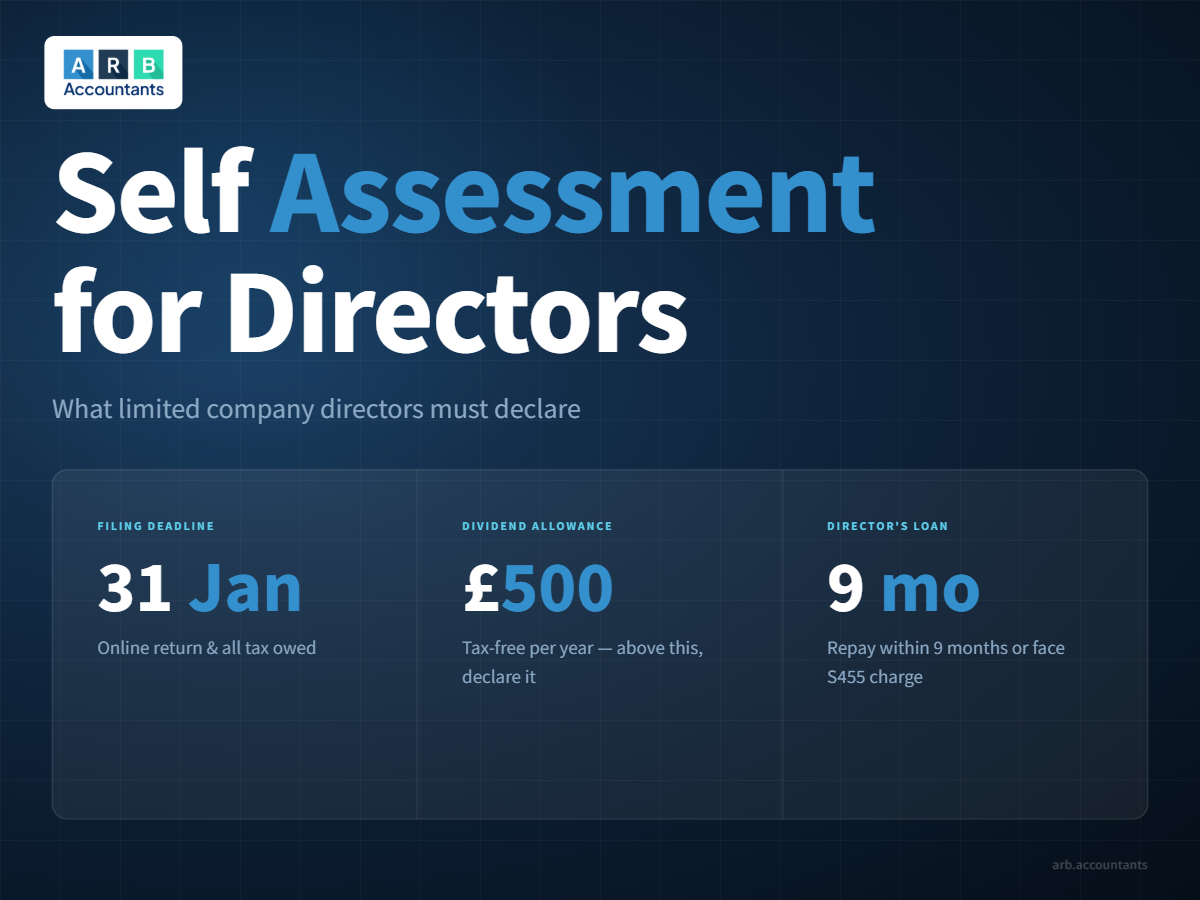
Most do. If you take dividends above £500, receive benefits in kind, have an overdrawn director's loan, or earn any income outside of PAYE, HMRC requires a personal self assessment tax return from you. Your company's Corporation Tax return covers the company. Your self assessment covers you personally. They are entirely separate obligations with separate deadlines.
Running a limited company keeps you busy. Between managing clients, keeping the company accounts in order, and filing with Companies House, it’s easy to assume your company’s Corporation Tax return covers your personal tax position. It doesn’t.
Self assessment for limited company directors is a separate obligation. Your company files its own returns. You file yours. If you take dividends, have an overdrawn director’s loan, or receive any income outside of PAYE, HMRC expects a personal tax return from you. Miss it, and the fines start immediately.
This guide covers what you need to know: when you need to file, how to register, what to declare, and the deadlines that can’t be ignored.
Table Of Contents
- Are Directors Classed as Self-Employed?
- Do All Directors Need to File Self Assessment?
- How to Register for Self Assessment as a Director
- What to Declare on Your Self Assessment Return
- Self Assessment Deadlines Directors Cannot Miss
- Dividend Tax: What Directors Pay
- Director’s Loans and Self Assessment
- Payments on Account: The Bill That Catches Directors Out
- Self Assessment vs Corporation Tax
- Common Mistakes Directors Make
Are Directors Classed as Self-Employed?
No. Being a director doesn't make you self-employed. You're an officeholder of a company, and the company is a separate legal entity from you as an individual. You don't register as self-employed — you register as an individual with additional income using form SA1.
You’re not a sole trader just because you run your own business through a limited company. But that doesn’t exempt you from filing. If you receive income that isn’t taxed at source, HMRC requires you to report it personally through self assessment.
When you register, you use form SA1 as an individual with additional income. You don’t register as self-employed. Getting that wrong can create HMRC account problems that are slow to untangle.
Do All Directors Need to File Self Assessment?
Not every director has to file. It depends on how you’re paid and what income you receive outside of PAYE.
You probably don’t need to file a self assessment tax return if your only income is a PAYE salary from your company, all tax is deducted at source, and you receive nothing else untaxed.
Self assessment for director filing becomes a requirement if any of the following apply:
- You receive dividends above the annual tax-free allowance (£500 for 2024/25)
- Your total dividends for the year exceed £10,000
- You have an overdrawn director’s loan not repaid within nine months of your company’s year end
- You receive benefits in kind, such as a company car, private medical insurance, or an interest-free loan
- You earn rental income, investment income, or savings interest above your Personal Savings Allowance
- You or your partner receive Child Benefit and one of you earns more than £60,000
- You receive income from abroad taxable in the UK
Most directors end up needing to file. Even a modest dividend above £500 triggers the obligation. HMRC can also issue a notice to file independently, making it compulsory regardless of your income position.
How to Register for Self Assessment as a Director
Company director self assessment registration is done online through HMRC's Government Gateway. You complete form SA1 to register as an individual with additional income, not as a self-employed person.
You’ll need: your National Insurance number, full name, current address and when you moved in, date of birth, and phone number.
Once submitted, HMRC posts your personal Unique Taxpayer Reference (UTR) within about ten working days. Your personal UTR is different from your company’s UTR for Corporation Tax. Don’t mix them up. You’ll need your personal UTR to sign in and file your return each year.
The registration deadline for first-time filers is 5 October after the end of the tax year in which you first received untaxed income. If you’ve missed that deadline and haven’t registered yet, do it immediately. The penalties for failing to register apply regardless of whether you’ve also missed the filing deadline.
What to Declare on Your Self Assessment Tax Return
Self assessment for limited company filing requires you to report all personal income for the tax year, not just income from the company.
Director’s Salary
Even though your PAYE salary is already taxed at source, it still goes on your self assessment return. HMRC uses the full picture to check your total tax position for the year and confirm the correct amount was deducted through payroll.
Dividends
Any dividends above the £500 annual allowance must be declared. If your total dividends exceeded £10,000, self assessment company director filing is mandatory regardless of how much tax is owed. You declare the gross dividend and HMRC calculates the tax after applying your available allowances and income tax band.
Benefits in Kind
If your company provided a company car, private medical insurance, or any other taxable benefit, it must appear on your return. Your company should issue a P11D by 6 July each year covering the previous year’s benefits. Check you’ve received one if these apply to you.
Director’s Loans
If your director’s loan account was overdrawn by more than £10,000 at any point during the year, it must be declared on your return. Similarly, if the company charges you interest below HMRC’s official rate, or if the loan is written off, personal tax consequences follow.
Other Personal Income
Rental income, freelance earnings, savings interest above the Personal Savings Allowance, pension payments, capital gains, and foreign income all belong on the return. Self assessment for director filing covers your full personal income picture, not just what came from the company.
Self Assessment Deadlines Directors Cannot Miss
Self assessment director of limited company obligations come with fixed deadlines. Missing any of them triggers automatic penalties. There’s no grace period.
| Deadline | What It Covers |
|---|---|
| 5 October | Register for Self Assessment (first-time filers) |
| 31 October | Deadline for paper tax returns |
| 31 January | Online filing deadline and payment of all tax owed |
| 31 July | Second Payment on Account (where applicable) |
The tax year runs from 6 April to 5 April. For the 2024/25 tax year ending 5 April 2025, you needed to register by 5 October 2025 and file online by 31 January 2026.
Late filing penalties: £100 the moment you miss the deadline. After three months, HMRC adds £10 per day for up to 90 days. At six months, a further 5% or £300 (whichever is higher). At twelve months, the same again. Interest also runs on unpaid tax from the due date.
Dividend Tax: What Directors Pay
Dividends are the main reason most directors need to complete company director self assessment returns. For 2024/25, the first £500 of dividends you receive is tax-free. After that, the rate depends on which income tax band you fall into once all your income is combined.
| Income Tax Band | Taxable Income | Dividend Tax Rate |
|---|---|---|
| Basic rate | Up to £50,270 | 8.75% |
| Higher rate | £50,271 to £125,140 | 33.75% |
| Additional rate | Over £125,140 | 39.35% |
Your income tax band is calculated on your total income: salary plus dividends plus anything else you receive. If your director’s salary sits just below the higher rate threshold and you take a dividend on top, part or all of that dividend may be taxed at 33.75% rather than 8.75%.
Dividend planning isn’t just about the amount you take. It’s about timing and how each withdrawal interacts with your other income. Those decisions should be made with your accountant, not after you’ve already declared everything.
Director’s Loans and Self Assessment
A director's loan is money you take from the company that isn't salary, a dividend, or an expense reimbursement. If the loan account is overdrawn at your company's year end, a nine-month clock starts.
The company has nine months and one day from its accounting year end to receive full repayment. If the loan isn’t cleared in time, the company faces a Section 455 tax charge of 33.75% on the outstanding balance. That’s a real cost to the business and entirely avoidable with forward planning.
For your personal self assessment return, you must declare a director’s loan if:
- The balance owed to the company exceeded £10,000 at any point during the year
- The company charges you interest below HMRC’s official rate
- The loan is written off
- You charge the company interest on money you’ve personally lent it
Director’s loans get genuinely complex in businesses where the balance fluctuates regularly through the year. This is one of those areas where professional advice before your year end is worth significantly more than dealing with the consequences after it.
Payments on Account: The Bill That Catches Directors Out
Self assessment company director obligations can include an additional payment that surprises many directors, particularly when they’re filing for the first time.
If your tax bill for the year exceeds £1,000, and less than 80% of your tax was collected through PAYE, HMRC requires Payments on Account. These are advance payments towards the following year’s tax bill, each equal to 50% of the current year’s liability.
The first falls on 31 January, alongside your current year’s payment. The second falls on 31 July.
A real-world example: You file your 2023/24 return and owe £4,000 in personal tax. HMRC calculates that less than 80% was collected via PAYE. Your 31 January bill becomes £4,000 for 2023/24, plus £2,000 as the first Payment on Account for 2024/25. Then another £2,000 due on 31 July. Your January payment is effectively three times what you expected.
First-year directors who take dividends regularly hit this without warning. Budgeting for Payments on Account from the moment you start taking dividends makes it manageable. Discovering it in January with no plan in place doesn’t.
Self Assessment vs Corporation Tax: Two Separate Things
Your company files a Corporation Tax return covering company profits and any tax the company owes. That's the company's return. Self assessment for limited company directors covers your personal income — the salary you took, the dividends you received, the loans you haven't repaid, the benefits the company provided.
Two separate filings, two separate tax liabilities, two separate HMRC deadlines.
Directors who confuse the two often believe that once the company’s Corporation Tax is filed and paid, their personal position is covered. It isn’t. HMRC tracks both independently, and a clean company record doesn’t protect you from personal filing penalties.
Common Mistakes Directors Make
Assuming PAYE covers everything. It covers your salary. Dividends, loans, and benefits are not captured by payroll.
Forgetting to declare dividends below £10,000. If they exceed £500, they must go on the return. The mandatory filing threshold is not the same as the tax-free allowance.
Leaving a director’s loan unrepaid past the nine-month window. The Section 455 charge is avoidable. Paying it because you forgot the deadline is frustrating and costly.
Missing the 5 October registration deadline as a first-time filer. HMRC doesn’t always send a reminder. You’re responsible for knowing when to register.
Not budgeting for Payments on Account. Your January bill can be substantially larger than expected when Payments on Account apply for the first time.
Using the company UTR for personal filing. Your personal UTR and your company’s UTR are different references. Always double-check before you submit anything.
A Caveat on Tax Rules
The rates, thresholds, and deadlines in this article reflect the position for 2024/25 and the information available at the time of writing. HMRC updates its rules regularly and thresholds change at each Budget. The Dividend Allowance has already been cut from £2,000 to £500 in recent years, which significantly changed the tax position for many directors.
Don’t rely on this article alone. Your own circumstances, other income sources, company structure, and the timing of decisions all affect what you owe. A qualified accountant who works with limited company directors can review your full position and make sure you’re meeting your obligations correctly and not paying more than you should.
Need help with self assessment as a director?
ARB Accountants prepares self assessment returns for limited company directors across the UK — covering dividends, director's loans, benefits in kind, and Payments on Account. ACCA-chartered. Fixed fees. No surprises in January.
Frequently Asked Questions
Does running a limited company make me self-employed for tax purposes?
No. You're a director and officeholder of a company. For self assessment purposes you register as an individual with additional income, using form SA1, not as a self-employed person.
Can I use my company's UTR for my personal self assessment return?
No. Your personal UTR is issued to you as an individual. Your company has its own UTR for Corporation Tax. These are separate and must never be used interchangeably.
What if I only take a salary and no dividends?
If your only income is a PAYE salary and all tax was deducted at source, you may not need to file. But HMRC can still issue a notice to file, which makes it compulsory. Check your Government Gateway account regularly.
What if I was a director for only part of the tax year?
You still need to declare any income received during your time as director. Self assessment for limited company positions covers the full tax year (6 April to 5 April), and you include only the income you received during that year regardless of when your appointment started or ended.
Do I need to file self assessment if the company made a loss?
Yes, if you received dividends, took benefits in kind, or have an overdrawn director's loan. Your company's trading position doesn't affect your personal self assessment obligation.
How far back can HMRC pursue unfiled returns?
Typically four years for innocent errors, six years for careless errors, and up to twenty years for deliberate behaviour. The fact that nothing has happened yet is not evidence that it won't.
What records do I need to keep?
Keep dividend vouchers, payslips, P60 and P45 forms, your P11D if benefits in kind apply, bank and investment statements, and full details of any director's loan transactions. HMRC requires records to be retained for at least five years after the 31 January filing deadline for that tax year.
About The Author

Gunjan Kataria | Client Accountant
Gunjan is a client accountant at ARB Accountants, providing personalised accounting support and financial guidance across VAT, PAYE, company accounts and personal tax returns.