Payrolled Benefits on Payslip: What They Are and How They Work
What does it mean when your payslip shows payrolled benefits?
If you see a line on your payslip labelled “Notional Pay”, “Payrolled Benefit” or something similar — such as “Notional Pay — Company Car” or “BiK — Private Medical” — your employer has registered to tax your benefits in kind through the payroll system rather than through the traditional P11D form.
Under the traditional system, employers reported benefits in kind once a year on a P11D form submitted to HMRC by 6 July. HMRC then adjusted employees’ tax codes for the following year to collect the tax retrospectively, often meaning employees paid last year’s benefit tax throughout the current year. The mismatch created confusing tax code adjustments and frequent underpayments or overpayments at year end.
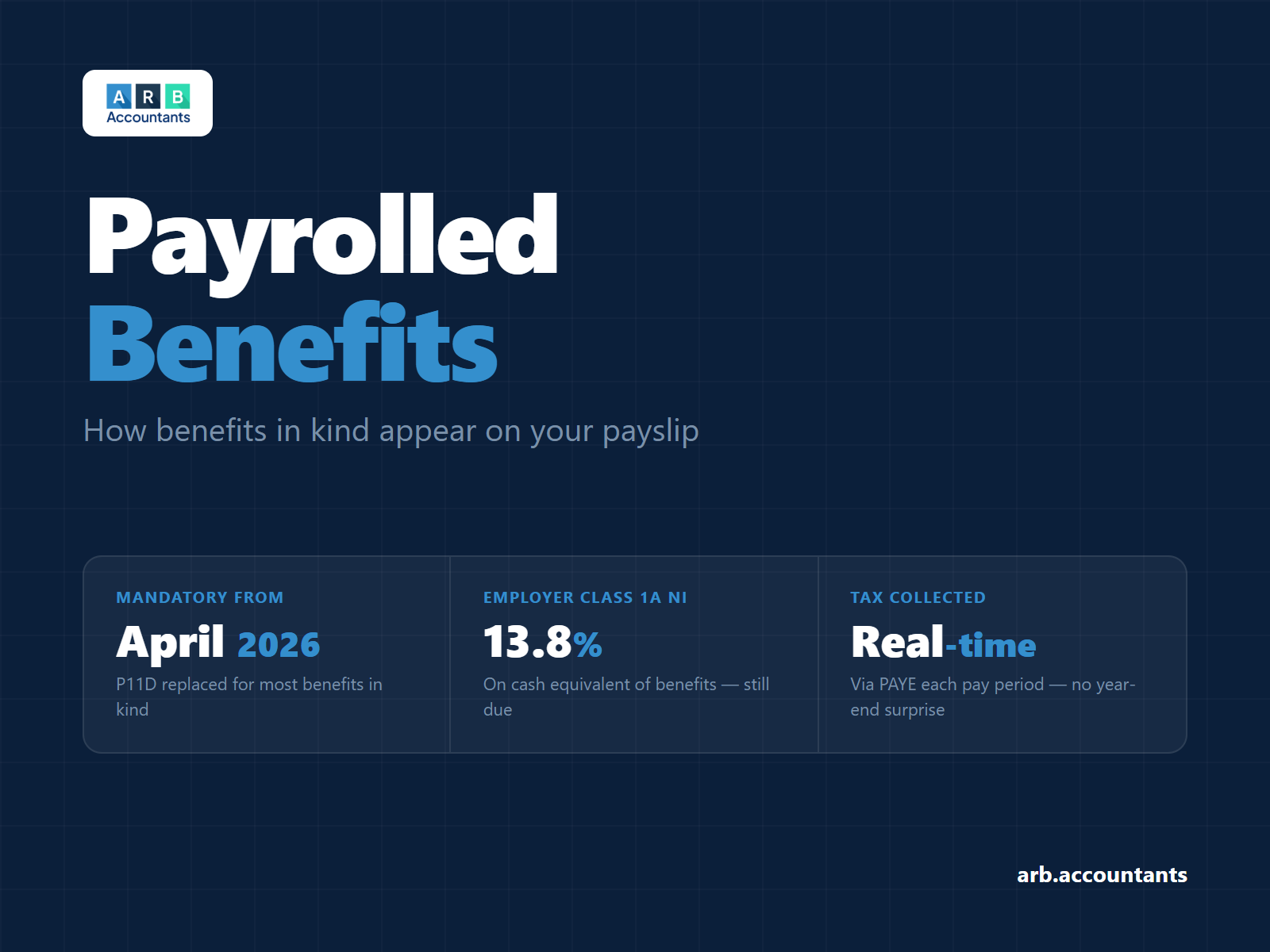
Payrolling replaces this. Instead of waiting until after the tax year ends, your employer adds the taxable value of your benefit to your gross pay each pay period. PAYE is calculated on your total — cash wages plus the notional benefit value — and deducted from your actual cash pay. Tax is collected in real time, the year-end adjustment problem largely disappears, and P11D forms become unnecessary for most benefits.
What are benefits in kind?
Benefits in kind (BiK) are non-cash perks your employer provides that have a taxable monetary value. HMRC treats them as part of your employment income because receiving them is economically equivalent to receiving cash and buying the same thing yourself.
Common benefits in kind include:
- Company car and fuel benefit
- Private medical and dental insurance
- Gym memberships and fitness facilities
- Professional subscriptions paid by your employer
- Employer-provided mobile phones above the single phone exemption
- Computer equipment made available for significant personal use
- Beneficial loans (interest-free or low-interest loans above £10,000)
- Employer-provided living accommodation
Not everything your employer provides is a benefit in kind. Workplace parking, employer pension contributions, employer-provided safety equipment, childcare vouchers issued before April 2018 and certain other items are exempt and do not appear on payslips or P11D forms.
How payrolled benefits appear on your payslip
When a benefit is payrolled, your payslip will typically show an additional line in the earnings section labelled with the benefit type. It will not appear in the payments section as money you receive — it will be shown separately, often as “notional pay” or with the specific benefit name.
A typical monthly payslip with a payrolled company car might look like:
| Description | Amount |
|---|---|
| Basic salary | £4,000.00 |
| Notional Pay — Company Car | £625.00 |
| Gross pay for tax | £4,625.00 |
| Income Tax (PAYE) | −£936.00 |
| Employee National Insurance | −£283.60 |
| Net pay (cash received) | £3,780.40 |
The £625 notional pay increases the income on which tax is calculated. The tax deduction goes up accordingly. But your take-home cash is calculated from your basic salary only — the £625 is not cash you receive and is not deducted from your net pay as a separate line. The extra tax is simply built into the PAYE figure.
This is often the source of confusion. Employees sometimes see a large gross pay figure and a correspondingly larger tax deduction and wonder why their net pay has not increased. The answer is that the notional pay element is taxable income in the eyes of HMRC but not cash in your hand.
How the notional pay figure is calculated
The notional pay amount on your payslip is the annual cash equivalent of your benefit divided by the number of pay periods in the year.
Example — company car:
- Car list price (P11D value): £30,000
- CO2 emissions benefit percentage (for 2025/26): 25%
- Annual taxable benefit: £30,000 × 25% = £7,500
- Monthly notional pay (12-period payroll): £7,500 ÷ 12 = £625
The benefit percentage for company cars is set by HMRC based on CO2 emissions and fuel type. Electric cars have a percentage of 2% for 2025/26. Diesel cars typically attract a 4% supplement on top of their emissions band percentage.
Example — private medical insurance:
- Annual premium paid by employer: £1,200
- Annual taxable benefit: £1,200
- Monthly notional pay: £1,200 ÷ 12 = £100
For medical insurance, the taxable value is the cost to the employer, not the market value of the policy.
Which benefits can and cannot be payrolled?
Most benefits in kind can be payrolled. Two categories remain outside the payrolling system and must still be reported on P11D forms:
Cannot be payrolled (P11D still required):
- Beneficial loans (interest-free or low-interest loans above £10,000)
- Employer-provided living accommodation
Can be payrolled (and will be mandatory from April 2026):
- Company cars and fuel benefit
- Private medical and dental insurance
- Gym memberships
- Non-cash vouchers (in most cases)
- Professional subscriptions
- Employer-provided equipment for personal use
- Other taxable expenses reimbursed by the employer
If your employer provides both a payrolled benefit and a beneficial loan, you will see notional pay on your payslip for the former and still receive a P11D for the latter.
What changes in April 2026: mandatory payrolling
Before April 2026, payrolling of benefits in kind was voluntary. Employers could choose to payroll some or all benefits, or continue with the traditional P11D route.
From April 2026, HMRC makes payrolling mandatory for most benefits in kind. P11D forms (for individual employees) are abolished for those benefits. All employers must:
- Register to payroll benefits in kind through their HMRC PAYE account
- Calculate and apply notional pay for each employee receiving a taxable benefit
- Collect PAYE on the benefit value in real time through their regular payroll
- Continue to submit a P11D(b) to report and pay Class 1A National Insurance
The two exceptions — beneficial loans and employer-provided living accommodation — remain on P11D reporting after April 2026.
For employers who have already been voluntarily payrolling benefits, the April 2026 change is largely administrative. For the majority who have been using P11D forms, it requires payroll software updates, benefit valuations and employee communications before the deadline.
The effect on your tax code
Under the old P11D system, HMRC adjusted your tax code to collect tax on your benefits in kind. A tax code of 1100L, for example, might reflect a personal allowance of £12,570 reduced by £1,470 to collect tax on a benefit worth £1,470. This reduced the amount of tax-free income in your code and increased the PAYE deducted from your salary throughout the year.
When your employer starts payrolling the same benefit, HMRC should remove the benefit adjustment from your tax code, because the tax is now being collected in real time through notional pay instead. If the adjustment is not removed, you end up paying tax twice on the same benefit — once through the notional pay calculation and once through the reduced tax code.
What to check if your employer starts payrolling benefits:
- Request an up-to-date tax code from HMRC or check it through your Personal Tax Account
- Look for any deductions in your tax code description related to benefits (for example “Company Car: £7,500”)
- If the deduction is still in your code after payrolling starts, contact HMRC at 0300 200 3300 or update through your Personal Tax Account
It can take HMRC a few months to update codes after payrolling begins, particularly mid-year. If you overpay tax as a result, HMRC will issue a refund after the year end when your actual tax position is reconciled.
Class 1A National Insurance — what changes for employers
Payrolling benefits does not remove the employer’s Class 1A National Insurance liability. Employers still owe 13.8% on the cash equivalent of most benefits in kind.
Under the traditional P11D system, employers submitted a P11D(b) by 6 July and paid Class 1A NI by 22 July. Payrolling does not change these dates. Employers still submit the P11D(b) and pay the Class 1A NI after the end of the tax year — the only change is that the individual employee P11D forms are no longer required for payrolled benefits.
HMRC has consulted on whether to align Class 1A NI payments with the real-time payroll cycle in future, which would mean employers paying their benefit NI monthly rather than annually. That change has not been legislated for the 2026 mandatory payrolling launch, so the annual cycle remains for now.
What employees should do now
If your employer has already started payrolling benefits, or will do so from April 2026:
Check your payslip. Look for notional pay lines and confirm the amounts make sense based on the benefits you receive. Query anything that looks incorrect with your payroll team promptly — mid-year corrections are possible but more complex than getting it right from the start.
Check your tax code. Log into your HMRC Personal Tax Account or call HMRC to confirm your tax code does not include adjustments for benefits being payrolled. Remove any duplicate adjustments to avoid overpaying throughout the year.
Expect a simpler year end. If your benefits are fully payrolled and your tax code is correct, you should reach the end of the tax year with no benefit-related underpayment or overpayment. For many employees this means less interaction with HMRC at year end — one of the genuine improvements the mandatory system brings.
Frequently Asked Questions
What does payrolled benefits on payslip mean?
It means your employer is taxing your benefits in kind through payroll each pay period rather than through a P11D form at year end. A notional value of the benefit is added to your gross pay for tax calculation purposes. No extra cash is paid — your PAYE deduction increases to reflect the benefit.
What are benefits in kind?
Non-cash perks from your employer with a taxable monetary value: company cars, private medical insurance, gym memberships, employer-paid professional subscriptions, beneficial loans above £10,000, and similar. HMRC treats them as employment income because receiving them is economically similar to receiving cash.
Why is there notional pay on my payslip?
Notional pay is the monthly portion of the annual taxable value of a payrolled benefit. It increases your gross pay for PAYE calculation purposes. You do not receive the notional amount as cash — it simply ensures tax on your benefit is collected in real time rather than through a year-end adjustment.
Do I still get a P11D if my benefits are payrolled?
No. If a benefit is payrolled, your employer does not submit a P11D for that benefit and you do not receive one. They may still submit a P11D(b) for their Class 1A National Insurance but you will not receive a personal P11D for payrolled benefits.
When does payrolling of benefits become mandatory?
April 2026. Before that date it was voluntary. After April 2026 most benefits in kind must be payrolled through PAYE. The two exceptions that remain on P11D reporting are beneficial loans and employer-provided living accommodation.
Which benefits cannot be payrolled?
Beneficial loans and employer-provided living accommodation cannot currently be payrolled and still require a P11D form. All other common benefits in kind — company cars, fuel benefit, private medical insurance, gym memberships, professional subscriptions — can and from April 2026 must be payrolled.
How is the notional pay figure on my payslip calculated?
Annual P11D value of the benefit ÷ number of pay periods. For a company car with a £30,000 list price at a 25% benefit percentage, the annual taxable value is £7,500. On a monthly payroll this gives £625 notional pay per month.
Does payrolling affect my tax code?
Yes. HMRC should remove any benefit adjustments from your tax code once payrolling starts, because tax is now collected in real time. If the adjustment remains in your code you risk overpaying. Check your Personal Tax Account and contact HMRC if the code still shows deductions for benefits being payrolled.
Do employers still pay Class 1A NI on payrolled benefits?
Yes. Payrolling does not remove the Class 1A NI liability. Employers still owe 13.8% on the cash equivalent of benefits and pay it via the P11D(b) by 22 July after the tax year ends. Only the individual employee P11D forms are removed for payrolled benefits.
Need Help With Payrolled Benefits or Payroll Compliance?
ARB Accountants manages payroll for businesses across the UK, including benefit-in-kind calculations, P11D compliance and the transition to mandatory payrolling from April 2026. Whether you are an employer preparing for the change or an employee with questions about your payslip, we can help.
ACCA-chartered. Fixed fees. Free 60-minute consultation.
Book a free consultation or call 01702 345 207.
Frequently Asked Questions
What does payrolled benefits on payslip mean?
Payrolled benefits on your payslip means your employer is taxing your benefits in kind (such as a company car or private medical insurance) through your monthly or weekly payroll rather than through the old P11D end-of-year form. A line on your payslip shows the notional value of the benefit added to your gross pay, which increases your taxable income for that period. No extra cash is paid — it is purely a calculation mechanism to ensure the right tax is deducted each pay period.
What are benefits in kind?
Benefits in kind are non-cash perks provided by your employer that HMRC considers taxable. Common examples are company cars and fuel, private medical or dental insurance, gym memberships, professional subscriptions paid by the employer, employer-provided mobile phones above the exempt threshold, and interest-free or low-interest loans above £10,000. They are taxable because they have a real monetary value even though they are not paid in cash.
Why does my payslip show notional pay?
Notional pay appears on your payslip when your employer has registered to payroll a benefit in kind. It is the monthly portion of the annual cash equivalent of your benefit. For example, if your company car has an annual taxable value of £7,500, your payslip will show £625 notional pay each month. This increases your gross pay for tax calculation purposes so PAYE is deducted on the benefit's value in real time.
Do I still get a P11D if my benefits are payrolled?
No. If your employer payrolls a benefit in kind, they do not submit a P11D for that benefit. This is one of the main advantages of payrolling — it removes the year-end P11D process for employees and employers alike. Your employer may still need to submit a P11D(b) to report and pay their Class 1A National Insurance on the benefits, but you will not receive an individual P11D form for payrolled benefits.
When does payrolling of benefits become mandatory?
From April 2026, payrolling of most benefits in kind becomes mandatory for all UK employers. Before that date, it was voluntary — employers could choose to payroll benefits or continue with P11D reporting. After April 2026, P11D forms will no longer be required for most benefits (excluding beneficial loans and employer-provided living accommodation), and employers who have not registered must do so.
Which benefits in kind can be payrolled?
Most benefits in kind can be payrolled, including company cars and fuel benefit, private medical and dental insurance, gym memberships, professional subscriptions, employer-provided mobile phones, computer equipment provided for personal use, and other employer-paid expenses with a taxable value. The main exceptions that cannot currently be payrolled are beneficial loans and employer-provided living accommodation, which must still be reported on P11D forms.
How is the notional pay figure calculated?
The notional pay figure is calculated by taking the annual cash equivalent (P11D value) of the benefit and dividing it by the number of pay periods in the year. For a monthly payroll: annual benefit value ÷ 12. For a weekly payroll: annual benefit value ÷ 52. For a company car with a P11D value of £30,000 and an emissions-based benefit percentage of 25%, the annual taxable value is £7,500. Monthly notional pay is £625.
Does payrolling benefits affect my tax code?
Yes, potentially. Under the old P11D system, HMRC adjusted your tax code to collect tax on benefits in kind through reduced allowances. When your employer payrolls the same benefits, HMRC should update your tax code to remove the deduction for those benefits — otherwise you would pay tax twice on the same benefit. Check your tax code after your employer starts payrolling. If it still shows deductions for payrolled benefits, contact HMRC to correct it.
Do employers still pay Class 1A National Insurance on payrolled benefits?
Yes. Payrolling does not remove the employer's Class 1A National Insurance liability. Employers still owe 13.8% Class 1A NI on the cash equivalent of most benefits in kind. The reporting method changes — employers submit a P11D(b) to declare the total benefit value and pay the Class 1A NI by 22 July (or 19 July by cheque) after the end of the tax year — but the liability itself remains.
What should I check if payrolled benefits appear on my payslip?
Check that the notional pay figure matches what you expect based on the benefit you receive. For a company car, you can calculate the expected figure using the car's list price and CO2 emissions percentage from HMRC's advisory tables. Also check that your tax code has been updated to remove any existing adjustment for the benefit — if your tax code still includes a deduction for a benefit being payrolled, you are at risk of over-paying tax. Contact your employer's payroll team or HMRC if anything looks wrong.
About The Author

Saurabh Bedi | Director
Saurabh is a tax advisor at ARB Accountants, specialising in Self-Assessment and small business tax. He's dedicated to making tax simple and stress-free, helping clients stay compliant and confident with HMRC.
Qualifications & Experience
- Fellow of Chartered Certified Accountants (ACCA)
- MSc Chartered Certified Accountancy 2008
- Working in accountancy since 2008