How to Read a Balance Sheet: A Guide for UK Business Owners
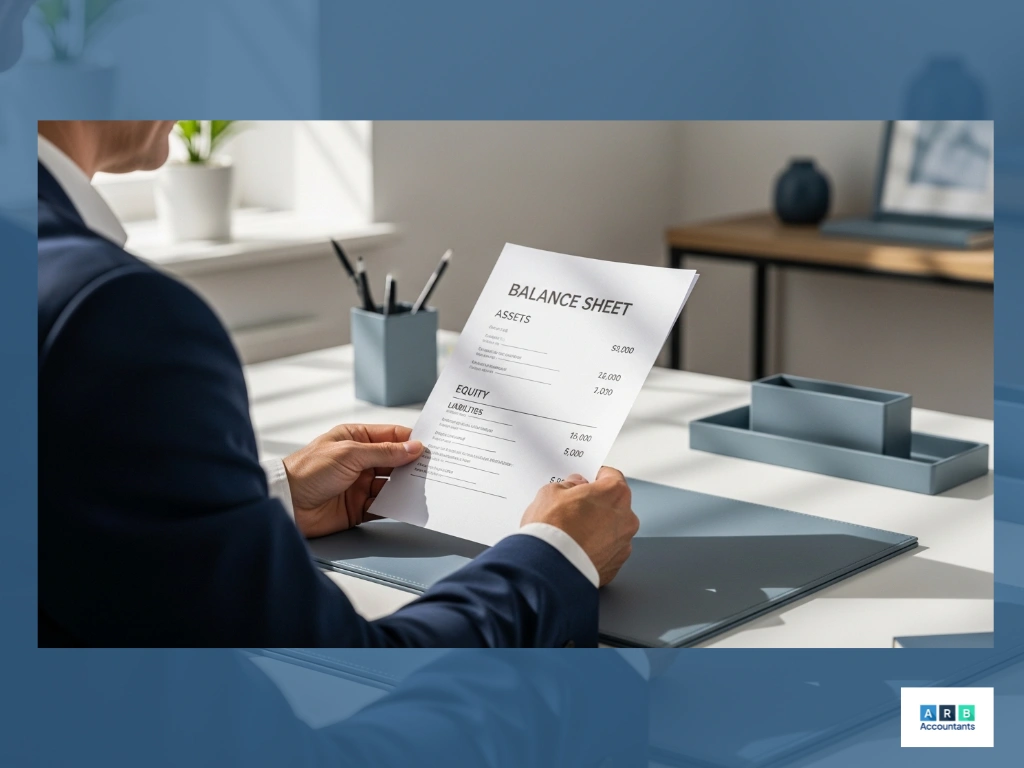
What Is a Balance Sheet? The Purpose of Balance Sheet Reporting
A balance sheet functions as a financial snapshot of your business at a single point in time, usually the last day of your financial year. The core equation guiding all balance sheets is: Assets = Liabilities + Equity.
What Does a Balance Sheet Show? Three Key Sections
Assets - What Your Business Owns
- Fixed assets (non-current assets): property, machinery, vehicles, equipment, and intangible assets
- Current assets: stock, trade debtors, and cash balances, listed by liquidity
Liabilities - What Your Business Owes
- Current liabilities: debts due within 12 months (trade creditors, VAT payable, corporation tax)
- Long-term liabilities: debts due after 12 months (bank loans, director’s loans)
Equity - What It Means for You
Equity represents the residual value after subtracting liabilities from assets. Growing retained earnings indicates healthy profit generation.
How to Read a Balance Sheet UK: A Worked Example
Consider a sample balance sheet:
- Fixed Assets: £85,000
- Current Assets: £39,700
- Current Liabilities: £15,700
- Long-Term Liabilities: £35,000
- Net Assets/Total Equity: £74,000
The balance sheet total is £124,700, representing the overall scale of business resources.
Where Is Debt on a Balance Sheet?
Debt appears in liabilities sections: short-term debt under current liabilities, long-term debt under long-term liabilities. A meaningful analysis compares total liabilities to total equity rather than examining debt in isolation.
How to Do Balance Sheet Analysis: How to Read a Balance Sheet Beyond the Basics
Current Ratio (Current Assets / Current Liabilities): In the example, £39,700 / £15,700 = 2.5. A ratio above 1 indicates the business can cover short-term obligations. Most lenders prefer ratios of 1.5 or higher.
Debt-to-Equity Ratio (Total Liabilities / Total Equity): In the example, £50,700 / £74,000 = 0.68. Lower ratios indicate greater reliance on equity financing rather than borrowing.
Working Capital (Current Assets - Current Liabilities): In the example, £39,700 - £15,700 = £24,000. This represents cash available for daily operations.
Understanding Financial Statements: How to Read a Balance Sheet in Context
A balance sheet should be reviewed alongside the profit and loss account and cash flow statement. A business owner who sees strong profits but wonders why cash is tight will often find the answer on the balance sheet. Together, these financial statements reveal the full picture of business performance, liquidity, and financial health.
What Are the Warning Signs on a Balance Sheet?
Red flags include:
- Rising trade debtors with flat or declining cash
- Current liabilities approaching or exceeding current assets
- Declining retained earnings year-over-year
- Unbalanced statements indicating errors
- Negative equity requiring immediate attention
Your Balance Sheet and Companies House: What UK Businesses Must File
Filing obligations depend on company size:
- Micro-entities (turnover under £632,000): simplified balance sheet under FRS 105
- Small companies (turnover under £10.2m): detailed balance sheet under FRS 102
- Medium and large companies: full accounts with extensive notes
Understanding your balance sheet enables you to assess business stability, evaluate debt levels, monitor payment timing, and track equity growth - factors determining staffing decisions, quarterly survival, and financing capacity.
Final Thoughts
Understanding how to read a balance sheet does not require an accounting qualification. It transforms a compliance document into a practical management tool for business decision-making.
Frequently Asked Questions
What is balance sheet information?
Balance sheet information shows what your business owns (assets), what it owes (liabilities), and the resulting net worth at a specific date.
Where is debt on a balance sheet?
Short-term debt appears under current liabilities; long-term debt under long-term liabilities.
What does equity in a balance sheet mean?
Equity in balance sheet terms is the residual value once you have subtracted all liabilities from all assets.
How often should I review my balance sheet?
Ideally monthly, not just annually, to enable proactive decision-making.
About The Author

Saurabh Bedi | Director
Saurabh is a tax advisor at ARB Accountants, specialising in Self-Assessment and small business tax. He's dedicated to making tax simple and stress-free, helping clients stay compliant and confident with HMRC.
Qualifications & Experience
- Fellow of Chartered Certified Accountants (ACCA)
- MSc Chartered Certified Accountancy 2008
- Working in accountancy since 2008