Flat Rate VAT Scheme: Is It Worth It for Your Business?
The Flat Rate VAT Scheme lets VAT-registered businesses pay a fixed percentage of their gross turnover to HMRC instead of tracking the VAT on every individual sale and purchase. For many small businesses the maths works in their favour. For others it costs more than standard accounting. The difference usually comes down to which sector you are in and how much you actually spend on goods.
This guide covers how the scheme works, who qualifies, how to find the right flat rate for your business and how to tell whether joining will save you money.
How the Flat Rate Scheme works
Under the standard VAT scheme you charge customers 20% VAT, reclaim VAT on purchases and pay the net difference to HMRC each quarter. That means logging every supplier invoice and reconciling input and output tax. The flat rate scheme removes most of that work.
You still charge your customers 20% VAT as normal. But instead of tracking VAT on purchases, you pay HMRC a single fixed percentage of your gross (VAT-inclusive) turnover for the quarter. The percentage is always lower than 20%, so in many cases you keep the difference.
Here is how the numbers look for a management consultant on a 14% flat rate. In a quarter they invoice £10,000 plus VAT.
- Gross income (including VAT at 20%): £12,000
- VAT collected from the client: £2,000
- Payment to HMRC (14% of £12,000): £1,680
- Retained: £320
The VAT Return itself takes minutes. You total your gross income for the quarter, multiply by your flat rate and pay that figure. No purchase ledger, no input tax claims.
Who can use the scheme
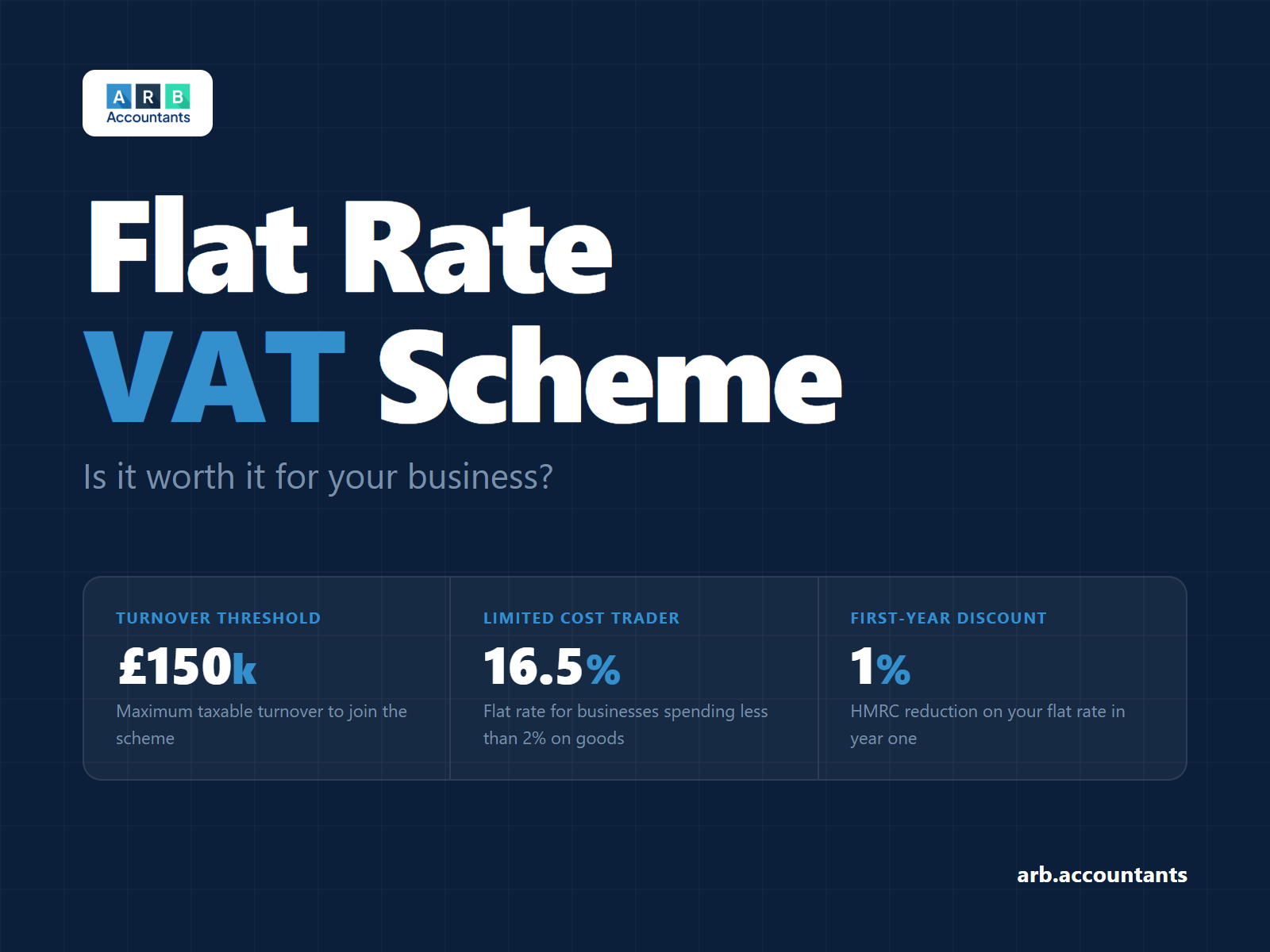
The Flat Rate Scheme is open to VAT-registered businesses with taxable turnover of £150,000 or less, excluding VAT, at the time of joining. You can remain on the scheme until your VAT-inclusive (gross) turnover reaches £230,000 in any rolling 12-month period. If you go above that figure, you must leave.
You are not eligible if you:
- left the scheme in the previous 12 months
- have been convicted of a VAT offence in the past year
- are closely associated with another flat rate business, for example a related company under common control
- joined or left a VAT group in the past 24 months
If you are registering for VAT for the first time you can apply for the flat rate scheme at the same time, which means you start it from day one.
Flat rate percentages by sector
HMRC sets a flat rate for each trade sector based on the typical VAT on purchases in that industry. Sectors with high costs get a lower rate; those with few goods purchases get a higher one. The full list covers over 60 categories.
| Trade or profession | Flat rate |
|---|---|
| Accountancy or bookkeeping | 14.5% |
| Computer and IT consultancy | 14.5% |
| Legal services | 14.5% |
| Management consultancy | 14% |
| Financial services | 12.5% |
| Real estate agent | 12% |
| Catering services | 12.5% |
| Hotel or accommodation | 10.5% |
| Transport or storage | 10% |
| General building or construction | 9.5% |
| Retail (food, confectionery, newspapers) | 4% |
If your business spans more than one category, use the one that most closely matches your main activity. If you are genuinely unsure, HMRC will confirm which rate applies if you ask in writing.
First-year bonus: in your first 12 months on the scheme, HMRC takes 1% off your flat rate. So a 14.5% rate becomes 13.5% for the first year. This applies whether you join at VAT registration or later.
The limited cost trader test
This is where the scheme trips people up.
If you spend less than 2% of your VAT-inclusive turnover on goods in a quarter, or less than £1,000 per year on goods, you are classified as a limited cost trader. That means you must use a flat rate of 16.5%, whatever sector you are in.
The definition of goods here is narrower than you might expect. It does not include:
- food and drink consumed by you or your staff
- vehicles and fuel
- capital assets
- subcontractors (counted as services, not goods)
For most consultants, freelancers and service businesses, the limited cost trader rules kick in immediately. At 16.5% of gross turnover, the scheme almost always costs more than using the standard VAT method.
Before joining, total up what you spend on qualifying goods in a typical quarter. If that figure is below 2% of your gross income, the standard scheme will almost certainly save you more money.
What you cannot reclaim
Under the flat rate scheme you give up the right to reclaim input VAT on everyday purchases such as software, office supplies, professional subscriptions and marketing. The flat rate is designed to account for that.
The one exception is capital assets costing £2,000 or more, including VAT, purchased as a single item. You can claim input VAT on those separately even while you are on the scheme. So if you buy a high-value piece of equipment you still get the VAT back on it.
Joining the scheme
You apply through your HMRC online business tax account. The process takes a few minutes and HMRC usually confirms your application within a few weeks. You can start from the date HMRC receives your application or from the beginning of your current VAT period, whichever works better for your records.
If you use accounting software, update your VAT settings to reflect the flat rate. Most platforms including Xero and QuickBooks have a flat rate mode that handles the calculation automatically.
When to leave or reconsider
The scheme is worth reviewing each year. The most common situations where it stops working are:
Your goods spend falls below the 2% threshold, pushing you into limited cost trader territory at 16.5%. Your sector rate increases. Your turnover climbs toward £230,000, or you take on more staff and your cost structure changes.
If you leave voluntarily you cannot rejoin for 12 months. HMRC will force you to leave if your turnover exceeds the threshold, and you will need to switch your VAT accounting back to the standard method from the start of your next period.
Is it worth it?
The flat rate scheme is most likely to save money if you are in a lower-rate sector, you have predictable gross income and your goods spend is consistently above the 2% threshold.
It is least likely to help if you are a service business with very little spend on goods, if your flat rate sector is above 14% or if you claim significant VAT on purchases each quarter.
The honest answer is that you need to test it against your own numbers. Take a recent quarter, calculate what you would have paid on the standard scheme and compare it to what the flat rate would have cost. If the flat rate comes out ahead, and you expect that to continue, it is worth joining.
Frequently asked questions
What is the Flat Rate VAT Scheme?
The Flat Rate VAT Scheme is a simplified VAT accounting method for small businesses. You charge customers VAT at the standard 20% rate, but instead of reclaiming VAT on purchases, you pay HMRC a fixed percentage of your gross (VAT-inclusive) income. The percentage varies by sector and is always below 20%, meaning the difference can stay in the business.
Who is eligible for the Flat Rate Scheme?
Businesses with taxable turnover of £150,000 or less (excluding VAT) can apply. You must leave if your total VAT-inclusive turnover exceeds £230,000 in any 12-month period. You are excluded if you left the scheme in the past 12 months, have a recent VAT-related conviction or are closely associated with another business already on the scheme.
How do I calculate VAT under the Flat Rate Scheme?
Multiply your total gross (VAT-inclusive) income for the quarter by your flat rate percentage. The result is your VAT payment to HMRC. For example, gross income of £12,000 at a 14% flat rate means you pay £1,680. You do not need to list individual purchases or calculate input VAT.
What is a limited cost trader?
A limited cost trader is a business that spends less than 2% of its gross quarterly turnover on goods, or less than £1,000 per year. HMRC requires limited cost traders to use a flat rate of 16.5%, regardless of their sector. Most service businesses, consultants and freelancers fall into this category, which usually means the scheme is not worth joining.
Can I reclaim VAT on purchases?
Generally no. Under the flat rate scheme you cannot reclaim VAT on day-to-day purchases. The exception is single capital asset purchases of £2,000 or more including VAT. You can reclaim the input VAT on those separately.
What is the first-year discount?
HMRC reduces your flat rate by 1% for the first 12 months you are on the scheme. A rate of 14.5% becomes 13.5% in year one. The discount applies from the date HMRC accepts your application.
Which flat rate percentage applies to my business?
It depends on your trade. Common rates include 14.5% for accountancy and IT consultancy, 14% for management consultancy, 12.5% for financial services and catering, 9.5% for construction and 4% for certain retailers. The full list is published by HMRC. If you are unsure, use the category that best reflects your main business activity.
What happens if I go over the threshold?
Once your VAT-inclusive turnover exceeds £230,000 in any rolling 12-month period, you must leave the scheme. You write to HMRC and revert to standard VAT accounting from the start of your next VAT period. You can reapply if your turnover falls back within the limits, but only after 12 months have passed if you left voluntarily.
Is the Flat Rate Scheme worth it for a sole trader?
It depends entirely on your costs. Service-based sole traders with very little goods spend typically fall under the 16.5% limited cost trader rate, which usually makes the scheme more expensive than standard accounting. If you spend regularly on goods and your sector rate is below 14%, it can save both tax and admin time. Compare a recent quarter under both methods before deciding.
How do I leave the Flat Rate Scheme?
You can leave voluntarily at any time through your HMRC online account or by writing to HMRC. Your flat rate accounting ends at the start of your next VAT period. If you leave voluntarily, you cannot rejoin for 12 months.
Frequently Asked Questions
What is the Flat Rate VAT Scheme?
The Flat Rate VAT Scheme is a simplified way for small VAT-registered businesses to account for VAT. Instead of calculating VAT on every sale and purchase, you pay HMRC a fixed percentage of your gross (VAT-inclusive) turnover. The percentage depends on your trade sector and is always lower than 20%, so the difference between what you collect and what you pay can work in your favour.
Who is eligible for the Flat Rate VAT Scheme?
You can join the Flat Rate Scheme if your taxable turnover is £150,000 or less (excluding VAT) when you apply. You must leave the scheme if your VAT-inclusive turnover exceeds £230,000 in any rolling 12-month period. You are also excluded if you left the scheme in the last 12 months, have a recent VAT conviction or are closely associated with another business already using it.
How do I calculate VAT under the Flat Rate Scheme?
You calculate your VAT Return by multiplying your gross (VAT-inclusive) turnover for the period by your flat rate percentage. For example, if you invoice £10,000 plus VAT and your flat rate is 14%, you multiply £12,000 (gross) by 14% and pay £1,680 to HMRC. You keep the £320 difference between the £2,000 you collected and the £1,680 you pay.
What is a limited cost trader?
A limited cost trader is a business that spends less than 2% of its VAT-inclusive turnover on goods in a quarter, or less than £1,000 per year on goods. If you fall into this category, you must use a flat rate of 16.5% regardless of your sector. Most service businesses, consultants and freelancers are affected. At 16.5% the scheme rarely saves money compared to standard VAT accounting.
Can I reclaim VAT on purchases under the Flat Rate Scheme?
Generally no. You cannot reclaim VAT on everyday business purchases such as software, subscriptions, office supplies or professional fees. The exception is capital assets costing £2,000 or more (VAT-inclusive) purchased as a single transaction. You can reclaim the VAT on those items separately even while you are on the flat rate scheme.
What is the first-year discount on the Flat Rate Scheme?
HMRC gives you a 1% reduction on your flat rate for the first 12 months you are on the scheme. So if your sector rate is 14.5%, you pay 13.5% in year one. This applies whether you join at the same time as registering for VAT or later.
What flat rate percentage does my business use?
HMRC publishes a full list of flat rate percentages covering over 60 sectors. Common rates include 14.5% for accountancy and IT consultancy, 14% for management consultancy, 12.5% for financial services and catering, 9.5% for general building and construction, and 10.5% for hotels. If your business spans more than one category, use the one that best matches your main activity.
What happens if my turnover goes over the Flat Rate Scheme threshold?
If your VAT-inclusive turnover exceeds £230,000 in any 12-month period, you must leave the scheme. You need to write to HMRC and switch back to standard VAT accounting. If your turnover drops again in future, you can reapply, though you cannot rejoin within 12 months of leaving voluntarily.
Is the Flat Rate Scheme worth it for a sole trader?
It depends on your costs. If you are a service-based sole trader with very little spend on goods, you will likely fall under the limited cost trader rules and face a 16.5% rate, which often makes the scheme less beneficial. If you are in a lower-rate sector and buy goods regularly, it can save both money and admin time. Running the numbers for a typical quarter is the best way to check.
How do I leave the Flat Rate VAT Scheme?
You can leave the scheme voluntarily at any time by writing to HMRC or using your online business tax account. Your flat rate accounting ends at the start of your next VAT period. If you leave voluntarily, you cannot rejoin the scheme for 12 months. HMRC can also remove you if your turnover exceeds the threshold or if you no longer meet the eligibility conditions.
About The Author

Saurabh Bedi | Director
Saurabh is a tax advisor at ARB Accountants, specialising in Self-Assessment and small business tax. He's dedicated to making tax simple and stress-free, helping clients stay compliant and confident with HMRC.
Qualifications & Experience
- Fellow of Chartered Certified Accountants (ACCA)
- MSc Chartered Certified Accountancy 2008
- Working in accountancy since 2008